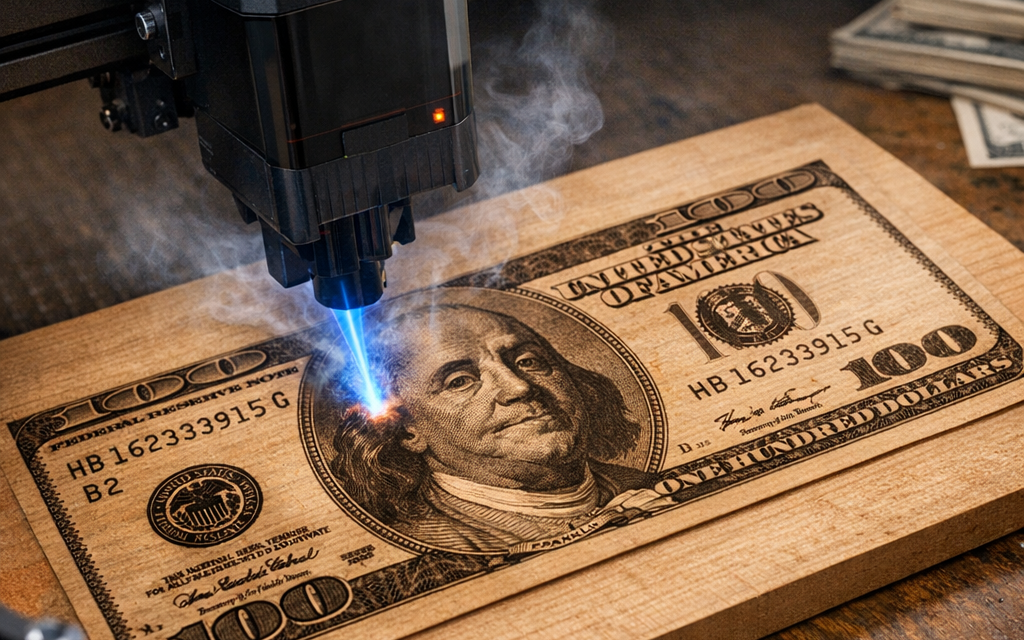
When I bought my Creality Falcon 2 a year ago, I saw it as a creative tool — something that would let me experiment, build, and maybe save a little money along the way. What I didn’t expect was just how quickly it would transform from a hobby purchase into a genuinely cost‑saving workhorse.
Twelve months later, the numbers speak for themselves: I’ve saved more money making things than I originally spent on the machine, and the momentum is only increasing.
From Hobby Tool to Value Engine
Laser cutters have a reputation for being niche tools, but the Falcon 2 proved the opposite. It became the go‑to solution for projects that would have otherwise required buying from Etsy creators, wargaming shops, or school supply stores.
Over the year, I used it for:
- Wargame terrain and accessories Custom buildings, scatter terrain, templates, tokens, bases — the kinds of things that normally cost a premium because they’re handmade or imported. Making them myself cut the cost to a fraction of retail.
- School projects for the kids Instead of buying foam boards, diorama kits, or pre‑cut shapes, I produced custom pieces on demand. Teachers loved the quality, and the kids got to bring in something unique.
- Household organizers and quick fixes Drawer inserts, labels, custom-fit parts — all the little things that add up when purchased individually.
Each project replaced something I would have bought. And because I tracked the “would‑have‑cost” value throughout the year, I watched the savings accumulate in real time.
You don’t have to become a seller to save money
The Falcon 2 wasn’t cheap, and I went into the purchase knowing it would take time to justify the cost.
Wargame terrain alone can easily run $20–$60 per piece, school projects that would have cost $10–$40 each, the savings stacked up quickly. Add in the household items and one‑off custom jobs, and the total value of what I produced surpassed the cost of the machine well before the year was over.
By the time I hit the one‑year mark, the tally was clear:
The Falcon 2 has saved me more money than I spent on it — and I feel like I’m just getting started.
More Than Savings: Skill, Creativity, and Capability
The financial benefit is only part of the story.
Over the year, I’ve gained:
- Confidence in designing and fabricating my own solutions
- A deeper understanding of materials and laser workflows
- The ability to create custom items that simply don’t exist commercially
- A creative outlet that doubles as a practical tool
The Falcon 2 didn’t just replace purchases — it expanded what was possible.
The Falcon 2 Features That Made the Difference
The savings didn’t happen by accident — they happened because the Falcon 2 has a set of features that make it fast, reliable, and capable enough to replace store‑bought items with high‑quality custom work.
- High‑Power Laser (40W)
- The cutting power is the backbone of the machine’s value. Being able to slice through thick basswood, MDF, and acrylic in a single pass meant I could produce durable terrain pieces and structural parts without outsourcing or buying pre‑made kits.
- Built‑In Air Assist
- Clean cuts, less scorching, and dramatically better edge quality. This alone made my wargame terrain look professional instead of “DIY.”
- Smart Camera System
- The camera made alignment effortless — especially for multi‑stage school projects or engraving on pre‑cut materials. It saved time, reduced mistakes, and made the machine feel more like a precision tool than a hobby gadget.
- Automatic Material Recognition
- This feature removed the guesswork. Drop in a material, let the machine detect it, and start cutting or engraving with confidence. It kept projects consistent and reduced wasted material.
Looking Ahead
What excites me most is that I’m still early in the journey. I’ve barely scratched the surface of what the machine can do, and every new project idea feels like another opportunity to save money, learn something new, or build something unique.
A year in, the Falcon 2 has proven itself not just as a hobby machine, but as an investment — one that continues to pay dividends in creativity, capability, and real financial value.