When Pixels Just Don’t Cut It Anymore
For decades, we’ve been obsessed with pixels. We count them, cram them onto screens, and try to make them look like reality. But when it comes to true, photorealistic 3D environments, pixels are actually a terrible starting point. Traditional methods for capturing the real world—like photogrammetry—force complex reality into triangles and meshes, resulting in digital models that look chunky, require extensive cleanup, and can choke a supercomputer if they get too detailed. It’s like trying to rebuild a gourmet cake by gluing crumbs together with geometry.
But now, thanks to some brilliant (and frankly, slightly unsettling) math, the future of visual reality is getting messy. Say goodbye to your precious polygons, because 3D Gaussian Splatting (3DGS) is here, and it’s turning the VFX world upside down. Welcome to the age of the “splat.”
What the Splat is a Gaussian?
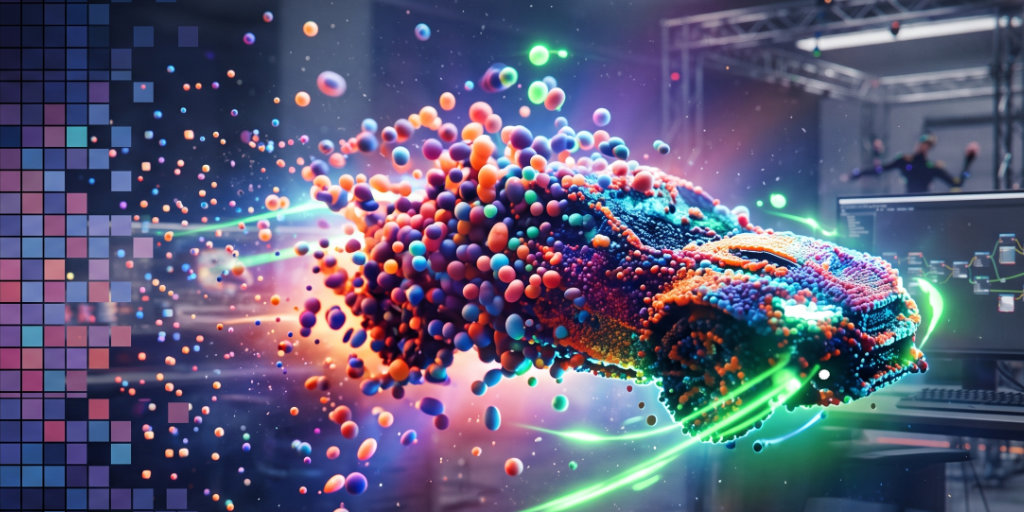
Forget meshes, clouds, or voxels. 3D Gaussian Splatting is a radical departure from classic computer graphics. Instead of using geometry (triangles) to define a shape, it uses millions—sometimes billions—of tiny, 3D, semi-transparent “smudges” or particles, each defined by a mathematical function called a Gaussian.
Each “splat” is essentially a compressed, high-fidelity packet of information: where it is in 3D space, how big it is (its shape and scale), its orientation, and how transparent and colorful it is. When you combine millions of these tiny, fuzzy packets and view them through a virtual camera, they blend together perfectly to recreate a scene with astonishing realism.
The magic of 3DGS is twofold. First, the capture process is lightning fast—you can scan an environment in minutes. Second, because rendering involves simply projecting these mathematical splats onto the screen, it bypasses the massive complexity of rendering millions of polygons. The result? Photorealistic digital twins that are nearly indistinguishable from reality, rendered at unbelievable speeds. The old way was like sculpting; the new way is like taking a high-res, 3D photograph that can be instantly moved, rotated, and lit.
The VFX Revolution is Already Splatting
In film and television, 3DGS is poised to replace photogrammetry entirely for creating “digital doubles” of locations. Imagine a location scout capturing a historic Roman street with a dozen cameras in a few minutes. That data, once processed, becomes a perfect, manipulable digital set extension that the VFX team can use without worrying about lighting artifacts or polygon count. It allows for unprecedented fidelity and speed in recreating complex real-world scenes, saving massive amounts of production time and money. It’s the difference between building a digital set brick-by-brick and just snapping a picture of the real thing and being done.
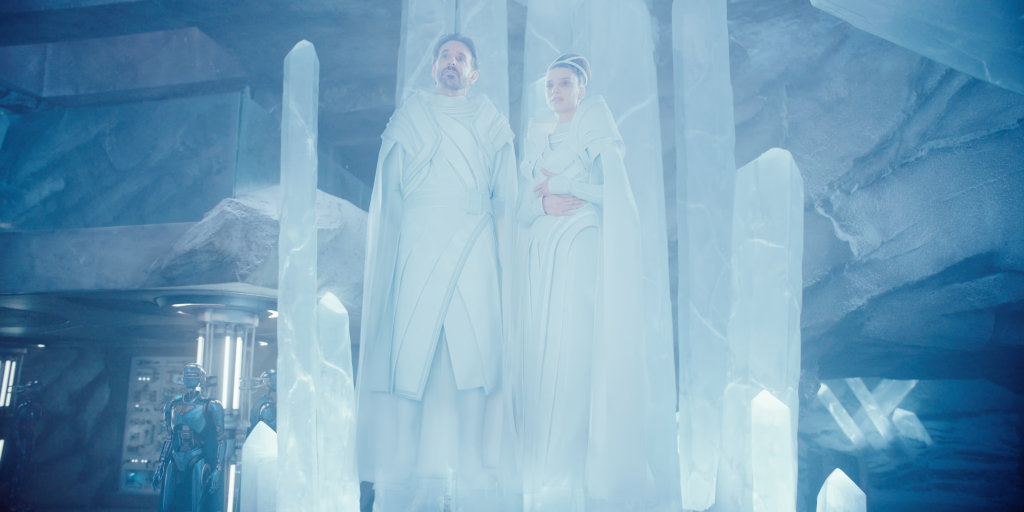
If you watched the latest Superman movie, then you’ve already seen 3D Gaussian Splats in action on the big screen
The Video Game Horizon
So, when will your PlayStation or Xbox start splatting? The potential for video games is perhaps the most exciting. Imagine open-world games built not from painstakingly modeled and textured assets, but from instantaneous, photorealistic 3D scans. You could turn a real-world city block into a game level in an afternoon.
The hurdle is optimization. While 3DGS renders shockingly fast compared to traditional methods, current implementations often rely on specialized GPU architectures to handle the massive volume of data (all those millions of splats). We’re waiting for the sweet spot: algorithms and engine integration that can manage real-time manipulation of a dense splat field on consumer-grade hardware. Companies are racing to solve this, and many industry insiders predict that hybrid engines—mixing traditional meshes with splat-based assets for environments and backgrounds—will start appearing in the next couple of years.
The pixel’s reign is ending. Soon, every digital world you enter, from the movie screen to your console, might be made of beautiful, colorful little splats. And honestly? It looks way better than geometry.