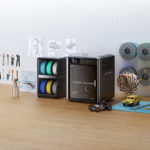
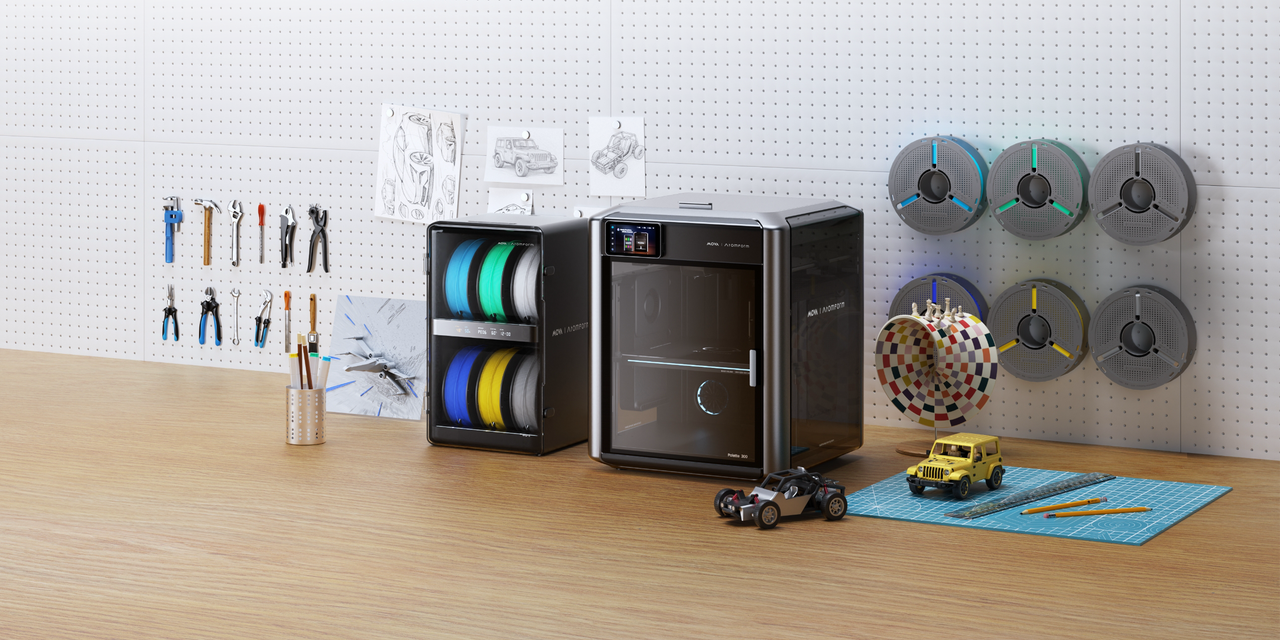
Las Vegas always brings surprises during CES, and this year, AtomForm came prepared. The Palette 300, a 12‑nozzle, AI‑powered, multi‑material printer that feels like the future of desktop fabrication finally arriving.
As someone who’s spent years dealing with filament swaps, purge blocks, and the heartbreak of multi‑material failures at hour 23 of a 24‑hour print, this announcement hits differently. The Palette 300 sounds like the next stage in 3D printers.
A 12‑Nozzle System That Actually Makes Sense
Most of us are used to one nozzle. Two if we’re lucky. Anything beyond that usually means a machine the size of a refrigerator and a workflow that requires a PhD.
AtomForm decided that wasn’t good enough.
The Palette 300 ships with 12 independent, filament‑dedicated nozzles, each ready to handle its own color or material. That means:
- Up to 36 colors in a single print
- Up to 12 materials at once
- No more reloading
- No more purging
- No more praying to the calibration gods
For anyone who’s ever tried to paint TPU onto PLA or blend rigid and flexible components without a dozen post‑processing steps, this is the kind of capability that feels almost unreal.
OmniElement™: The Secret Sauce
At the heart of the Palette 300 is AtomForm’s new OmniElement™ Automatic Nozzle Swapping System, which promises lightning‑fast transitions with up to 90% less waste.
If that number is even remotely accurate, it’s a game‑changer. Multi‑material printing has always been powerful in theory but painful in practice because of the sheer amount of filament wasted during swaps. The Palette 300 seems to have solved that bottleneck with a combination of smart engineering and AI‑driven optimization.
AI Watching Every Layer So You Don’t Have To
The Palette 300 packs 50+ sensors and 4 AI‑powered cameras that monitor everything from nozzle alignment to micro‑defects. It’s like having a silent lab assistant who never blinks.
The system automatically calibrates, detects issues before they become failures, and maintains a wild ±0.02mm precision. That’s industrial‑grade accuracy in a machine designed for home studios and classrooms.
As someone who has lost entire weekends to layer shifts, humidity‑ruined filament, or a nozzle that decided to clog at 3 a.m., this level of oversight is the kind of thing I’ve been begging for.
Built for Real Creative Spaces
Despite all the tech packed inside, the Palette 300 runs at ≤48 dB—quiet enough to sit next to you while you work. It also includes built‑in air purification, which is a huge win for anyone printing in shared spaces or small studios.
And if you’re the type who buys filament like it’s going out of style, you’ll appreciate this: the Palette 300 integrates with up to six RFD‑6 Filament Boxes, supporting 36 spools with independent drying systems that run even during prints.
Specs That Don’t Hold Back
Here’s what stands out:
- 12 Auto‑Swapping Nozzles
- Up to 36 Colors & 12 Materials
- OmniElement™ + ReadyPrint™ Swap Tech (up to 90% less waste)
- 800 mm/s Speed & 25,000 mm/s² Acceleration
- 50 Sensors + 4 AI Cameras
- ≤48 dB Operation with Air Filtration
This isn’t a “prosumer” machine. It’s a professional‑grade tool disguised as a desktop printer.
A Quote That Sums It Up
Jagger Shang, AtomForm’s Head of Product, put it perfectly:
“The Palette 300 isn’t about incremental improvement—it’s about removing the long‑standing barriers of multi-color, multi-material 3D printing.”
For once, that doesn’t feel like marketing fluff. It feels like exactly what this machine is built to do.
When Can We Get It?
The Palette 300 is set to launch in early Q2 2026 at a price of $2,199, with Kickstarter pre‑order discounts coming in early Q1.
If the real‑world performance matches even half of what AtomForm is promising, this could be the most important desktop 3D printer release in years.
And yes—I’m already planning what I’m going to print first.