The Battle for Your Eyeballs
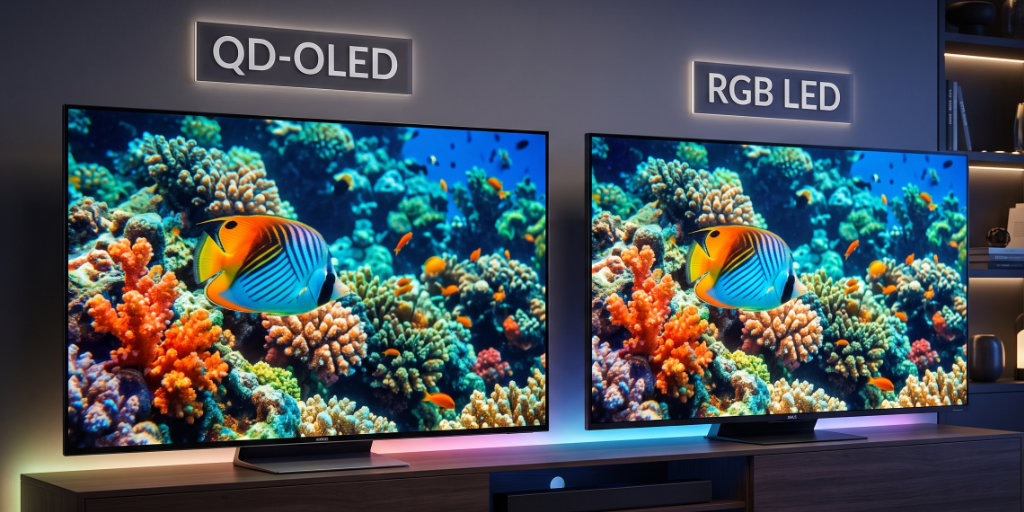
Walk into any big-box electronics store, and you’re immediately assaulted by a wall of glowing rectangles, each one promising to show you colors so vibrant they’ll make your real life look like a dusty 1950s sitcom. You’ll see acronyms like OLED, QLED, Mini-LED, and now the heavyweights: QD-OLED and high-end RGB LED. But beneath the marketing gloss and the slow-motion footage of colorful fruit, which tech actually deserves a spot in your living room? Is there a true “ultimate” display, or are we just choosing our favorite flavor of expensive light?
QD-OLED: The Overachieving Hybrid
First up is QD-OLED—the tech world’s attempt at a “greatest hits” album. It takes the perfect blacks and infinite contrast of traditional OLED (where every pixel can turn off completely) and slaps a layer of Quantum Dots on top. Instead of using a white sub-pixel to boost brightness—which can sometimes wash out colors—QD-OLED uses a blue light source that passes through those quantum dots to create pure red and green.
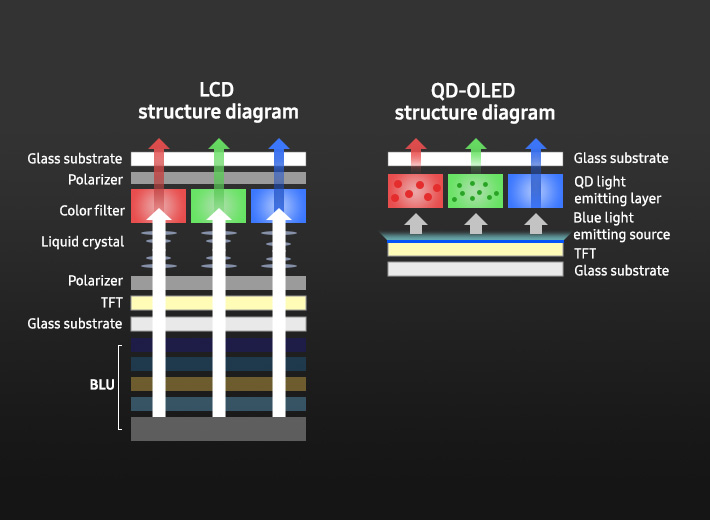
The structure of QD-OLED is much simpler than LCD. (Image courtesy Samsung)
The result? It’s basically OLED on steroids. You get the deep, soul-crushing blacks that make space movies look incredible, but with a brightness and color saturation that makes standard OLEDs look a bit polite and shy. It’s the “have your cake and eat it too” of display tech. The downside? It’s still an OLED at heart, which means there’s a non-zero chance of “burn-in” if you leave a news ticker running for 4,000 hours straight, and your wallet will definitely feel the burn first.
RGB LED: The High-Octane Flashlight
On the other side, we have high-end RGB LED (often seen in advanced Mini-LED setups). This is the culmination of decades of refining the “light behind a liquid crystal” formula. By using thousands of tiny LEDs and sophisticated local dimming, these TVs can reach levels of brightness that QD-OLED can only dream of. If you’re watching TV in a room that’s basically a sunroom, an RGB LED set is your best friend. It’ll cut through glare like a lightsaber through a Tauntaun.
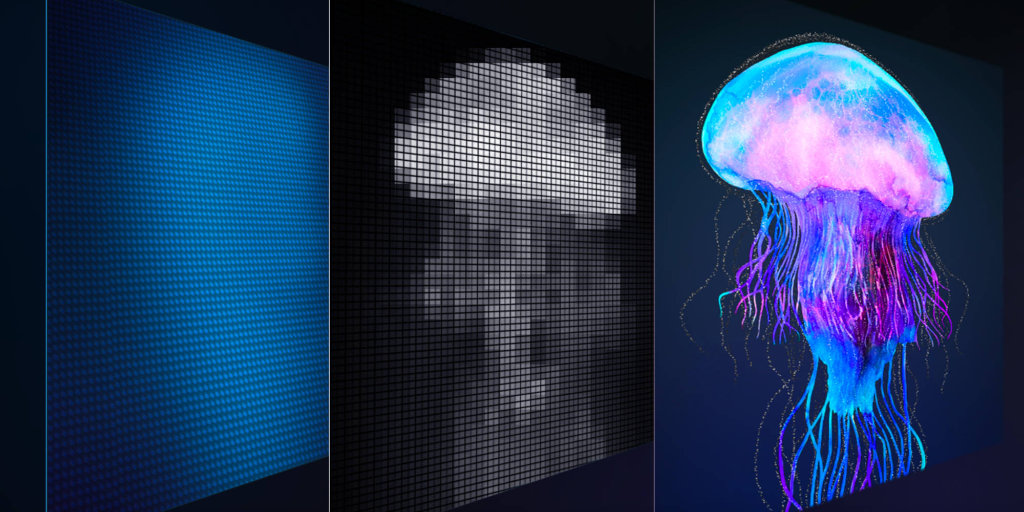
RGB OLED minimizes (but doesn’t eliminate) the “blooming” artifacts that are inherent to backlight arrays. (Image courtesy Best Buy)
The “RGB” part means it uses dedicated red, green, and blue LEDs to create a wider color gamut. However, even with the best dimming zones, you still occasionally get “blooming”—that annoying halo of light around bright objects on a dark background. It’s like the TV is accidentally revealing its secrets. It’s powerful, it’s reliable, and it’ll never burn out, but it can’t quite match that “perfect” inkiness of an OLED.
The Verdict: Still Waiting for the Savior
So, is either one “ultimate”? Not quite. Choosing between them is a game of trade-offs. Do you want perfect contrast and “chef’s kiss” color accuracy (QD-OLED), or do you want blinding brightness and long-term durability (RGB LED)? Most of us are just picking the one that best hides our messy living room reflections.
The true “Holy Grail”—Micro LED—is still hanging out in the “insanely expensive” category. Micro LED promises the self-emissive perfection of OLED with the brightness and longevity of LED, without the downsides of either. But until you can buy a Micro LED TV for less than the price of a mid-sized sedan, we’re stuck in the QD-OLED vs. RGB LED cage match. Grab your popcorn; whichever you choose, your cat’s whiskers have never looked sharper.