
If you want to download a new game or productivity tool on an Android device today, the Google Play Store is the undisputed, de facto heavyweight champion. It’s the digital watering hole where everybody gathers. But gather ’round, young geeks, because it wasn’t always a one-horse race. Back in the wild west days of early Android—an era defined by slide-out keyboards and physical trackballs—alternate app stores were actually a pretty big deal.
While most of those early competitors have long since vanished into the digital ether, one plucky storefront has stubbornly persisted since almost the very beginning: the Amazon Appstore. However, after years of hanging on like a cat dangling from a screen door, it looks like Amazon’s digital storefront might finally be closing up shop.
A Brief History of the Everything Store’s App Store
Let’s take a quick trip down memory lane. Launched way back in 2011, the Amazon Appstore stands proud as one of the longest-running alternate app ecosystems in Android history. If you are old enough to remember their legendary “Free App of the Day” promotion, you deserve a veteran’s discount. For over a decade, it served as the exclusive, iron-fisted gatekeeper for downloading apps on Amazon’s wildly popular Fire devices.
But it wasn’t just trapped on budget-friendly tablets; for years, you could sideload the Appstore onto virtually any regular Android phone. That all changed last year, when Amazon quietly slammed the door shut and made the Appstore completely inaccessible to non-Amazon devices. It was the first real red flag that the winds of change were blowing.
Enter the Alexa Tablets (and Google Play)
The real plot twist arrived with the recent launch of Amazon’s brand-new line of Alexa tablets. Positioned to completely replace the aging, ubiquitous Fire lineup, these new slates bring a massive, fundamental paradigm shift. Instead of running Fire OS—which, let’s be honest, has always technically just been Android wearing a very restrictive, Amazon-branded trench coat—the Alexa tablets run standard Android.
And here is the absolute kicker: for the first time in Amazon’s hardware history, these new devices rely entirely on the Google Play Store instead of the Amazon Appstore. It’s a huge win for consumers who no longer have to hack Google services onto their cheap tablets, but it’s a glaring admission from Amazon that fighting the Play Store behemoth is a losing battle.
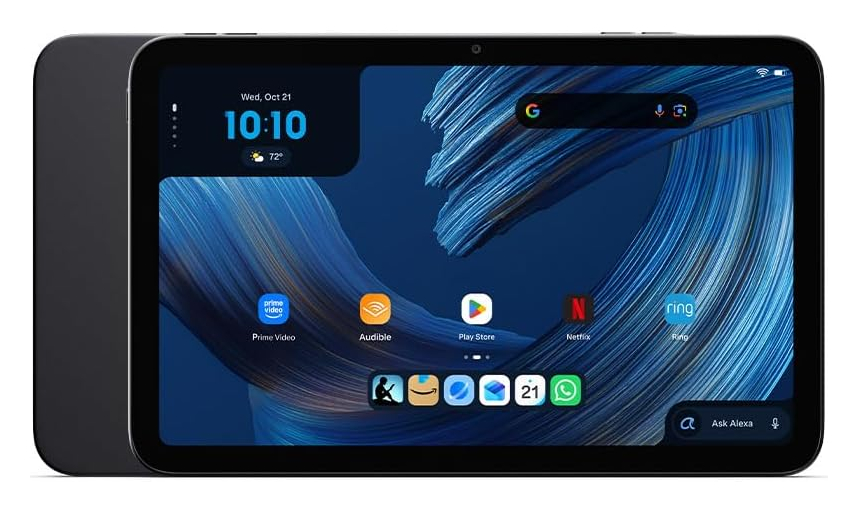
Behold, Amazon’s latest tablet, with a shiny Play Store icon on the home screen.
The Elephant in the Room and the Appstore’s Future
So, is the Amazon Appstore totally dead? Not exactly, at least not today. There are still millions upon millions of legacy Fire OS devices actively in service, meaning Amazon can’t just pull the plug overnight without inciting a massive user revolt. Furthermore, the incredibly popular Fire TV lineup still relies heavily on the Appstore to deliver streaming apps to your living room.
However, the writing is definitely on the wall in permanent marker. We can fully expect the Appstore to be slowly phased out across all of Amazon’s future hardware launches. And we have to acknowledge the elephant in the room: Google’s notoriously strict third-party app store policies have always made it incredibly difficult (though not totally impossible) for alternate storefronts to gain any meaningful friction on standard devices. With Google Play now officially taking the reins on Amazon’s flagship tablets, the Amazon Appstore’s slow, gentle fade into tech obscurity seems all but inevitable. Rest in peace, old friend—we’ll never forget all those free copies of Fruit Ninja.