Battery technology has become one of the most important battlegrounds in modern engineering, and I talk about batteries often because it’s the quiet force shaping the future of transportation, computing, and energy storage. Every major leap in mobility, from hybrids to full EVs, has been tied directly to what’s happening inside the battery pack. Right now, Toyota is standing at a crossroads where battery innovation isn’t just a competitive advantage… it’s a matter of survival.
Over the last year, Toyota has publicly acknowledged a “sense of crisis” inside the company. Engineers have admitted they’re losing ground to China’s rapid EV expansion, and leadership has warned that Toyota “cannot survive” unless it accelerates its next‑generation electric strategy. That strategy centers on two things:
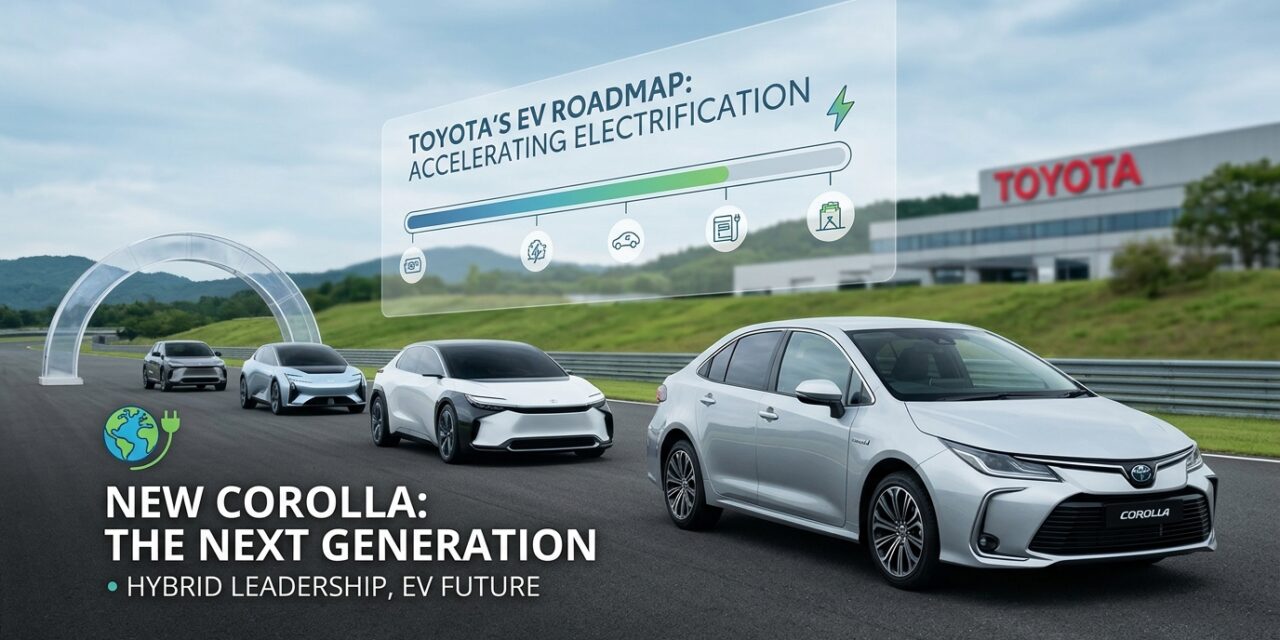
- A battery roadmap running from 2025 to 2027 that shows their innovation and the future of their platform
- A make‑or‑break vehicle: the next‑generation Corolla EV
Let’s break down what’s happening—and why it matters.
Toyota’s Battery Roadmap (2025–2027)
Toyota’s battery plan is built around four sections, each serving a different price point and performance tier.
1. Performance Lithium‑Ion (2026)
Designed for mainstream EVs, this year targets:
- 800 km range
- 20% cost reduction vs the bZ4X
- 20‑minute fast charging
- Square cell format for thinner, more aerodynamic pack designs
This is Toyota’s first real attempt at a competitive long‑range EV battery.
2. Popularisation LFP (2026–2027)
This is the battery that could reshape Toyota’s global footprint:
- Bipolar LFP architecture
- 40% cheaper than current packs
- Extremely long cycle life
- 30‑minute fast charging
- Ideal for compact, affordable EVs
If Toyota wants to compete with BYD’s Dolphin or Tesla’s Model 3 Standard Range, this is the battery that makes it possible.
3. High‑Performance Lithium‑Ion (2027/28)
For premium Toyota and Lexus EVs:
- Bipolar high‑nickel chemistry
- 1,000 km range
- Faster discharge and acceleration
- Advanced cooling required
This is Toyota’s “halo” long‑range battery—meant to show what the company can do at the high end.
4. Solid‑State Batteries (2027)
The crown jewel of Toyota’s roadmap:
- 450–500 Wh/kg energy density
- 0–80% charge in ~10 minutes
- 1,000–1,200 km range
- First deployed in Lexus EVs
Solid‑state is the technology Toyota has been promising for over a decade. If they deliver, it will be one of the biggest leaps in EV history.
The Next‑Gen Corolla EV: Toyota’s Survival Strategy
Electrek recently reported that Toyota is betting heavily on the next‑generation Corolla EV—so heavily that executives have said the company’s future depends on it. That’s not hyperbole. Corolla is the best‑selling car in history, with over 57 million units sold. If Toyota can electrify Corolla successfully, it instantly becomes a global EV powerhouse.
What We Know About the Corolla EV
- Built on a new multi‑powertrain platform (BEV, hybrid, PHEV, ICE)
- Shares design DNA with the Corolla Concept shown at the Japan Mobility Show
- Expected to use either Performance Li‑ion or Popularisation LFP batteries
- Multiple body styles under development (sedan, hatchback, crossover, GR performance)
- Developed at a “top‑secret” engineering site due to competitive pressure
This isn’t just another EV. It’s Toyota’s attempt to build a global, affordable, scalable electric Corolla; a car that can compete with BYD, Tesla, Hyundai, and VW in every major market.
Why Toyota Is Feeling the Pressure
- BYD has overtaken Ford and is targeting Toyota next
- Chinese EVs are cheaper, faster to market, and increasingly higher quality
- Toyota’s previous EV efforts (like the bZ4X) were widely criticized
- The Lexus LF‑ZC program was canceled, putting more weight on Corolla EV
Toyota knows it’s behind. The Corolla EV is their chance to catch up.
Why Batteries Matter More Than Ever
I talk about batteries a lot because they’re the foundation of most electronics and EVs clearly wouldn’t be an exception. Range, charging speed, cost, safety, longevity and every one of these factors comes down to battery chemistry and architecture. Toyota’s roadmap shows a company finally embracing the reality that battery innovation determines market leadership.
If Toyota’s 2025–2027 battery plan succeeds:
- Corolla EV becomes a global best‑seller
- Solid‑state batteries redefine long‑range EVs
- Toyota maintains its position as the world’s top automaker
If it fails:
- BYD overtakes Toyota by 2030
- Corolla Hybrid becomes a relic of a slow transition
- Toyota loses dominance in compact cars
These are obviously just my thoughts with possible outcomes, but a realistic view of the next few years.
Final Thoughts
Toyota’s battery roadmap is ambitious, overdue, and absolutely necessary. The next‑gen Corolla EV is the company’s most important vehicle in recent memory; not because it’s flashy, but because it represents Toyota’s attempt to reinvent itself in a world where battery technology is the new engine.