
Let’s face it: travel is already expensive enough without your own bank deciding to nickel and dime you for the privilege of spending your hard-earned cash abroad. Between flights, accommodations, and that third gelato of the afternoon, the absolute last thing you need is to hemorrhage money on sneaky foreign transaction fees and horribly unfavorable exchange rates.
For the purpose of this Galactigeek guide, we’re going to assume that your money is currently sitting in glorious US dollars (USD). By the time we’re done, you’ll know exactly how to protect those dollars from the vampires of international banking.
The Gauntlet of Global Fees
Before we get into the solutions, let’s take an overview of all the fees you can encounter when converting from USD to a foreign currency. It’s like a terrible boss battle where the enemy just keeps spawning minions. For example, when you confidently swipe your standard credit card in Paris, your bank might casually slap you with a foreign transaction fee. Need cash? When making an ATM withdrawal, you might be charged a currency conversion fee, on top of an out-of-network ATM fee from your home bank, plus a usage fee from the foreign ATM operator. That’s up to three separate fees in just one single transaction!
It’s enough to make you want to barter with physical seashells. Fortunately, if you’re prepared before you pack your bags, you can eliminate almost every single one of the fees you encounter.
Swiping Smart: Credit Card Transactions
Your first line of defense is right in your wallet. You should check your current credit card policy to see if there is a foreign transaction fee (spoiler alert: if it’s a basic card, there probably is). The good news is that many travel-focused cards offer zero foreign transaction fees as a standard perk. If you don’t have one of these cards yet, get one immediately—there are plenty of fantastic options out there that don’t even charge an annual fee.
Once you have the right card, there’s a psychological trap you need to avoid at the checkout counter. When using your card abroad, the payment terminal will sometimes prompt you to complete the transaction in USD. It looks comforting and familiar, but decline it! This is a deceptive little feature called Dynamic Currency Conversion, and it will usually result in a spectacularly unfavorable currency conversion rate. Always, always, always choose to spend in the local currency. Let your zero-fee credit card handle the math; that’s what you got it for!
Beating the Machine: ATM Withdrawals
Sometimes, cash is king, and you’re going to need to hit an ATM. Believe it or not, there are banks that offer zero foreign transaction fees for ATM withdrawals. Even better, if you’re lucky enough to bank with the right institution, they will actually waive or reimburse all of the ATM transaction fees—even the ones incurred by the greedy foreign ATM operator.
Charles Schwab and Fidelity are two such financial providers that provide all of these magical perks (for the record, #NotSponsored, we just genuinely love keeping our money). With the Schwab Bank Visa® Platinum Debit Card, for example, you get unlimited ATM fee rebates worldwide. Just as with credit card payments, you have to stay vigilant at the screen. If the ATM kindly offers to make your withdrawal in USD, aggressively press “Decline.” Always use the local currency option to ensure you’re getting the best possible exchange rate.
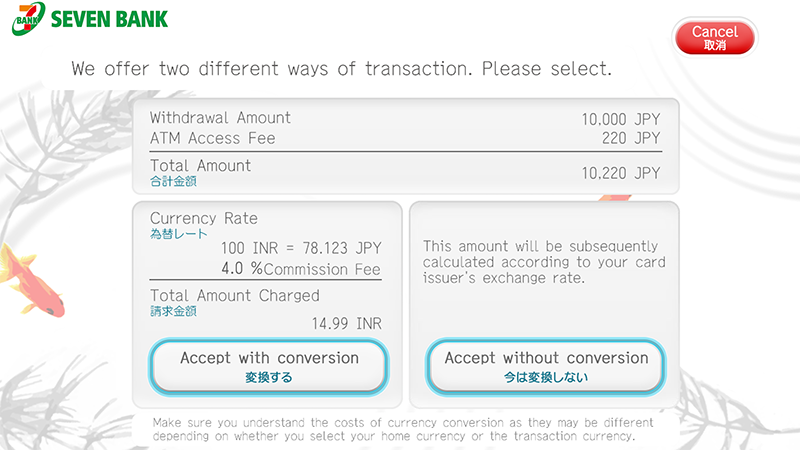
An example of an ATM “currency conversion” screen.
In this example, select “Accept without conversion” on the right to avoid an extra 4% markup on your withdrawal.
The Final Boss: The Network Markup
We’ve eliminated the foreign transaction fees, dodged the currency conversion traps, and eradicated the ATM charges. But there is one final fee that you usually can’t avoid: the credit/debit network markup. This is the fee that the overarching payment network operator (like Visa or Mastercard) charges to process a transaction from one currency to another across the globe.
The surprisingly good news? This fee is usually nominal, so you don’t need to lose sleep over it. For example, when I tested the rate to convert USD to Japanese Yen using a Visa card, the network markup was a measly 0.11%. If you’re a true Galactigeek and want to crunch the exact numbers yourself, Visa and Mastercard each have an official exchange rate calculator site where you can check the real-time markup rate (AMEX doesn’t have a similar site that I could find). It’s a tiny price to pay for the magic of beaming your money across the planet instantly!