The Quest for the Holy Grail of EV Batteries
Let’s be honest. When you think of a glorious electric future, you picture zipping down the highway, charging up in five minutes flat, and driving for a thousand miles, all while laughing maniacally at gas prices. Right now, though, EV ownership often involves a healthy dose of range anxiety and long, soul-crushing waits at public chargers. It’s like having a superhero suit that needs a 45-minute nap every time it fights a minor villain.
Enter the solid-state battery: the mythical, futuristic tech that promises to fix all our problems. It’s the EV industry’s equivalent of a warp drive—everyone wants it, everyone is building it, and nobody has actually shipped a working, mass-produced version yet. So, when can we finally plug into this electric utopia?
Lithium-Ion’s Lame Little Secret
To understand the hype, you first have to understand what we’re driving now. Your current EV (or phone, or laptop) runs on lithium-ion batteries. These use a liquid or gel electrolyte, which works fine, but has two main downsides: it limits energy density (how much juice you can cram in) and, occasionally, it decides to have a fiery, thermal runaway party.
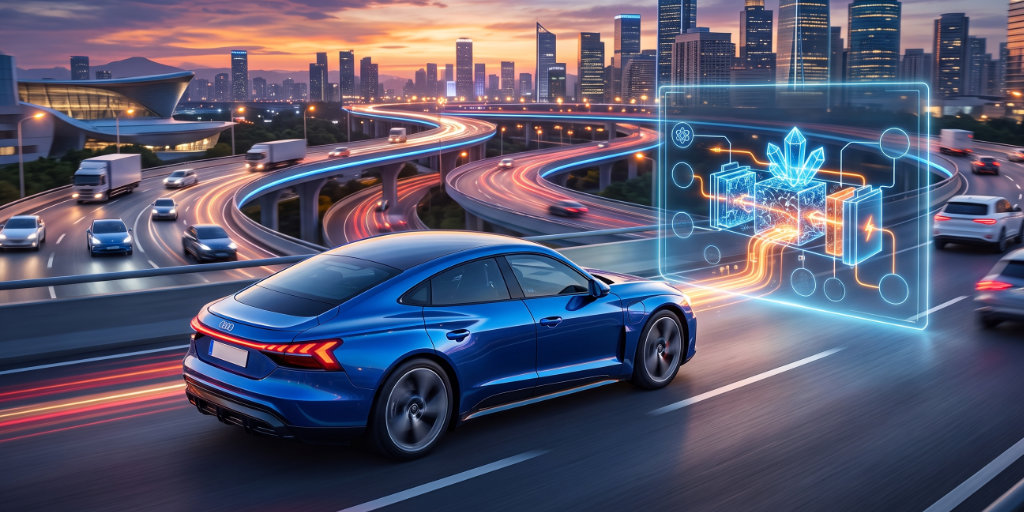
Solid-state batteries swap that sloshy, flammable goo for a solid ceramic or polymer electrolyte. This simple change is a game-changer. Imagine: you get vastly higher energy density, meaning more range without a heavier battery. You get crazy fast charging because the solid material handles rapid ion transfer better. And, most importantly, they are inherently safer—they’re far less likely to turn your garage into a dramatic fireworks display. It’s like upgrading your battery from a temperamental high-school science project to a nuclear-powered diamond.
The Manufacturing Monster
So, why aren’t they here yet? Because inventing something awesome in a lab and mass-producing it cheaply are two vastly different problems. Right now, companies are battling the manufacturing monster.
The biggest hurdles are cost and stability. Solid-state electrolytes are notoriously fragile; scaling up production without creating microscopic cracks or gaps that reduce performance is a nightmare. Furthermore, the interfaces between the solid electrolyte and the electrodes must remain perfect through thousands of charge cycles. If they don’t, you get tiny, needle-like structures called dendrites forming, which can pierce the solid electrolyte and kill the battery. The engineering required is so precise it makes Swiss watchmaking look like kindergarten finger painting.
Major players like Toyota, QuantumScape, and multiple Chinese manufacturers are pouring billions into this. Toyota, a long-time solid-state advocate, has targeted 2027/2028 for the initial launch in high-end, niche vehicles. QuantumScape, backed by Volkswagen, is also making progress, aiming for commercialization shortly after that.
The Forecast: Get Ready to Wait (a little)
Here’s the cold, hard truth, wrapped in a comfortable tech-blanket: mass-market solid-state EVs are not a 2025 thing. They are a late 2020s/early 2030s reality.
The first generation of solid-state batteries will likely appear in super-premium, low-volume vehicles (think six-figure sports cars or limited-run luxury models) around 2027 or 2028, largely for bragging rights and to test the tech in the wild. We’ll start seeing them trickle down to mainstream, purchasable vehicles in high volume around 2030 to 2032.
Until then, we’ll be stuck with our current liquid-lithium-ion setups, which are getting better every year, thankfully. But don’t despair. That solid-state future is coming. It just might arrive on a boat, charging slowly, because, well, that’s just how the future of charging goes.