

We’ve all been there: you finally pull the trigger on that “deal” you saw on Amazon, only to find out a week later that you paid twenty bucks more than you would have if you’d just waited until Tuesday. Retailers love to play games with pricing, and it can feel like you need a degree in data science just to buy a coffee maker without getting ripped off. Thankfully, Amazon is finally handing us a tool to fight back: the new price history feature in “Alexa for shopping.”
Finally, the Truth Behind the Price Tag
If you’ve been shopping on Amazon lately, you might have noticed a new set of data points on product listings. Instead of just seeing the current price, you can now toggle between 30-day, 3-month, and even 1-year pricing charts. It’s a total game-changer for the chronic overthinker. For years, we’ve been flying blind. We rely on “sale” tags that are about as reliable as a weather forecast in a hurricane. Is that 20% off sticker actually a deal, or did they just hike the price last night so they could lower it today?
With this new feature, you no longer have to guess. You can see the actual trends, meaning you can stop relying on “gut feelings” and start making decisions based on actual market reality. It’s like Amazon decided to pull back the curtain on its own wizardry.
Avoiding the Black Friday Bait-and-Switch
The biggest winner here is your wallet, especially during those high-pressure sales events. We all know the classic Black Friday trick: retailers inflate the price of a product for a few weeks leading up to the holiday, only to “discount” it back to its normal price on the big day. You walk away feeling like a hero who saved $50, when in reality, you just paid the exact same price that the item has been selling for since August.
With the price history tool, that manipulation is glaringly obvious. When you see a “sale,” you can quickly check if the price was actually lower last month. If the graph shows a spike right before the discount, you’ll know exactly when to walk away. It’s the digital equivalent of catching a magician mid-sleight-of-hand.
The “Wait-and-See” Strategy: A Case Study
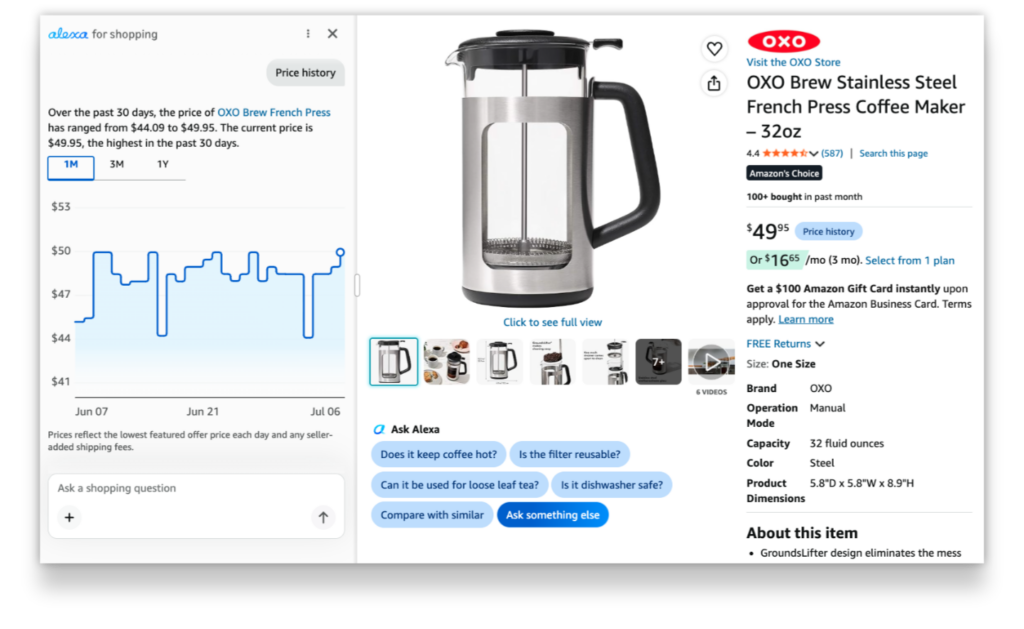
Let’s take a look at a real-world example. I was recently eyeing the OXO Brew Stainless Steel French Press. If I had just looked at the current price, I might have assumed it was a standard deal. But checking the 30-day price history reveals something telling: the price has been bouncing between $44.09 and $49.95, and right now, it’s sitting at $49.95—the absolute peak of the last month. Do I buy it now? Absolutely not. Unless I’m desperate for coffee this exact second, the data tells me to hold off. I’m essentially paying the “I-can’t-wait” tax. By waiting a few weeks, I’m statistically likely to save five or six dollars. It’s not a fortune, but it’s enough for a latte on the way to work.
Alexa for shopping isn’t just a gadget—it’s the ultimate reality check for our impulses. So before you smash that “Buy Now” button, take a second to look at the chart. Your bank account will thank you.