
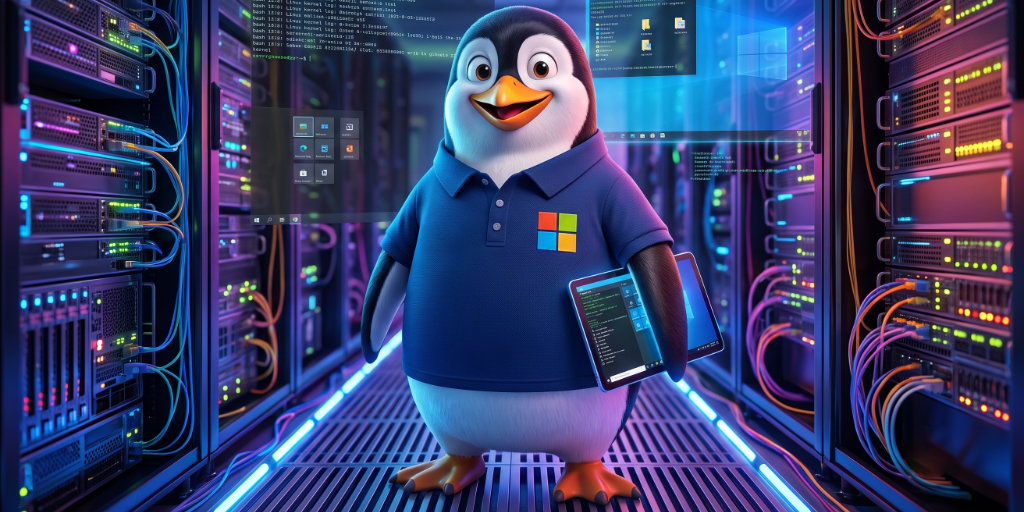
Steve Ballmer once famously called Linux a “cancer.” Today, it feels more like Microsoft’s favorite new outfit—one they’ve tailored, accessorized, and started wearing to every board meeting. If you’ve been paying attention to the weird, wild transformation of the Windows ecosystem, you might have started wondering: is the NT kernel—the beating, aging heart of Windows—eventually going to be replaced by the Linux penguin?
It sounds like the kind of conspiracy theory you’d find scrawled on a dusty tech forum, but look at the evidence. Microsoft’s path from “Linux is the enemy” to “Linux is everywhere” is one of the most drastic corporate pivots in history.
The Linux Trojan Horse
It started with the Windows Subsystem for Linux (WSL), which quietly let us run Linux tools without needing a bulky, resource-hogging virtual machine. But Microsoft didn’t stop there. They recently introduced Coreutils for Windows—a set of UNIX-style command-line utilities built with Rust.
Now, you can use grep, cat, and find natively on Windows, just like it’s a standard Tuesday in a terminal emulator. By bringing these native, cross-platform utilities to the desktop, Microsoft is effectively smoothing out the friction between their OS and the rest of the tech world. It’s not just sneaking into the basement anymore; Linux has basically moved into the master bedroom.
Cloud Cover and the “Solara” Shift
Then there’s the cloud. Microsoft’s Azure Linux distribution proves they aren’t just using Linux—they’re building it, refining it, and relying on it to run the internet’s heavy lifting. And while Microsoft’s upcoming “Project Solara”—an AI-first, agent-driven platform—is officially about revolutionizing smart devices, it’s another major tell.
Solara utilizes a chip-to-cloud architecture that feels suspiciously liberated from the heavy, legacy baggage of the NT kernel. By building fresh, lean software experiences for agent-first devices, Microsoft is proving they can build an OS that doesn’t need the NT foundation to survive.
The Boring Economics of Kernels
So, why would they eventually ditch NT for a Linux base? The answer is as boring and brutal as a spreadsheet: profit margins. Desktop operating systems aren’t the cash cows they used to be. Maintaining a monolithic, proprietary kernel like NT is a massive, expensive drag on resources. Every patch, every driver update, every security fix for NT is a line item in a budget that Microsoft would probably rather spend on AI or cloud services.
Linux, by contrast, is free, battle-tested, and already runs the world. Imagine a world where Windows is essentially a highly polished, proprietary desktop environment (a “shell”) sitting on top of a lean, mean, Linux-based foundation. It would be the ultimate hack: Microsoft keeps the brand loyalty and the enterprise ecosystem, but offloads the soul-crushing work of kernel maintenance to the global open-source community.
Will it happen tomorrow? Probably not. The sheer amount of legacy software that would break if Windows swapped kernels would cause a collective scream loud enough to be heard in space. But don’t be surprised if, ten years from now, your “Windows” is just a fancy UI layer running on a Linux base. The NT kernel might not be dying, but it’s definitely looking over its shoulder. And honestly? If it means a faster, cleaner Windows that doesn’t feel like it’s fighting itself half the time, the Linux-ified future might just be the best thing to happen to the PC.